
My desktops, both the physical one and the digital one, are chock full of early American genealogies that I still want to explore. You would think that decades of research from Georgia to Maine, and so much more research than my book could hold (not to mention the giant plastic tubs of notes in my bastement, I’d be done with this. But no. After more than a year and a half of traveling to talk about my book, Lineage, visiting ever more libraries, mostly–but not always– ones I’m returning to, and more mornings to spend a quiet minute in digital collections, I’ve gathered up many more compelling examples of ways that men and women, rich and poor, free and unfree reflected on their family connections. There are so many fascinating ways that each one is specific and yet also fits into important patterns.
This week I’m doing a virtual event with the New Hampshire Historical Society, and I wanted to come back to a very cool set of materials I started working with two years ago. I was reading a very rich set of family records by and about Samuel Lane (1718-1806) of Stratham New Hampshire online, and ordered images so I could share them here and on my Instagram, @VernacularGenealogy, with the Historical Society’s permission.
Lane was described by an early 20th century editor of his writings as “one of the most systematic of men.” Oh indeed. He was systematic and prolific. A tanner and shoemaker, Lane was also a local official and, always, a prodigious keeper of records of various kinds. He’s emblematic of a phenomenon I’ve written about in Chapter 4 of Lineage, what I call the “chroniclers,” men who wrote extensively in their professional life (in Lane’s case accounts and local records) and then also did so for their personal, family life.
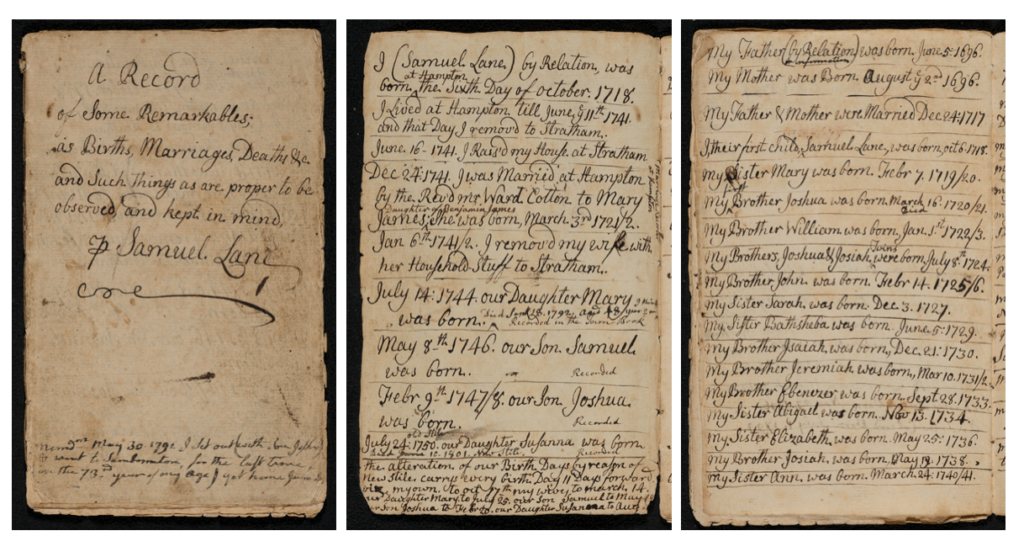
I’m focused here on the pages of Lane’s “Record of Some Remarkables; as Births, Marriages, Deaths & c and such things as are proper to be observed, and kept in mind.” What an intriguing title! “Some Remarkables” is a charming but also carefully descriptive phrase that captured the family details that Lane asserts were “proper” to be both “observed” and “kept in mind.” I haven’t (yet!) held this family record, only looked at the images of all 10 pages, but it is very akin to other small handsewn record books. It is 20 unnumbered pages, including the front (title) and back (blank) pages. On the first page Lane records to start his own birth, his wife’s, their marriage, their settlement at Stratham, and their first children. He wrote a single block of textual information, followed by an ink line to distinguish from the next. Through the pages he recounts his wife Mary’s death, after 27 years of marriage, and his remarriage to a woman not much younger than himself. His second wife was nearly 50, and they had no children together. He went on to note the lives of his children and grandchildren. Each of his children were allotted a half page on whcih Lane recorded his grandchildren’s births (and some deaths).
There are a couple of notable features of Lane’s record of “Remarkables.” In addition to the care with which Lane recorded this information, carefully detailing dates, he invokes his ancetors implicitly at the beginnig of the text and exoplicitly at the end. The very beginning of his record notes that he was born “at Hampton the 6th day of Octobr 1718.” But crucially he crafts it this way: “I (Samuel Lane) by Relation, was born at Hampton…” In other words, he knows this information because this was what was told to him– related to him. So these ancestral narrators are present in his text from the very first line. On page 14, after the accounts of his marriage, children and grandchildren, Lane turned back to previous generations, starting with his own parents. And he used the same formualtion to describe: “My Father (by Relation) was born June 5, 1696.” Samuel was “their first child” of 15, all named with their birthdates, again using the pattern of a line separating their individual information.
He also described deeper ancestral connections, noting that his great grandmother had died in January of 1733 and “I think she was more than 90 years old.”
Second, Lane was quite reflective about his family relationships. He wrote about losing his wife, Mary, when she was 46. “We lived together in the Marriage Relation 27 years & 26 days.” He married again more than five years later, to a woman he explcitly described as “my second wife.” And it must be said, he married age appropriately!
Lane’s family record book forms only one part of a rich collection in Samuel Lane’s hand that includes a genealogical table that looks to be his work as well, and account and other record books. We know that he kept an extensive diary that was published in 1937 by a descendant.
The Lane Family Papers at the New Hampshire Historical Society are so rich, and I’ve clearly only begun to dig in. As ever I am grateful to the society for a good finding aid, for some digital views, and for facilitating the images that I have used here, by permission. The Lane home and other materials are preserved in New Hampshire, and I’ve got a note to stop by on my next trip north.