
In a previous post I described how a 1750 court record, a bond between two men for the exchange of enslaved persons, reflected genealogy both as information and practice. This idea, that genealogy was deeply embedded in British America, is at the heart of my book, Lineage. I’m going to keep writing a bit more about diferent kinds of sources, textual, visual, and material, explaining in detail how we see genealogy appearing in each and how each is a form of what I call “Vernacular Genealogy.”
This is another court record, also from Virginia, in this case a 1773 freedom suit in which people being held in bondage argued that they were being held illegally. It was tried in the Virginia General Court in Williamsburg, and the plaintiffs are charging “assault, battery & false Imprisonment.” The bundle of testimony is digitized by the Library of Virginia and available through Virginia Untold.
The case landed in a complex time for freedom suits based on free maternal ancestry. While Virginia was one of the few colonies that passed a statute confirming maternal heritable slavery, many acted as if it was positive law and enslaved the children of women they enslaved. The status of enslaved Indigenous people was similarly confused—never clear in the law (which went back and forth about whether it was legal to enslave Indians as opposed to African and African-descended people), in practice many Indians were enslaved. This is the subject of important knowledge within tribal communities as well as scholarship.
Yet the early 1770s were an auspicious moment for launching such a case. In 1772 Virginia’s General Court decided a key case; the plaintiffs’ lawyer in Robin v. Hardaway argued for Indians’ inherent right to freedom, and determined freedom on the basis of descent from not only a free mother, but an Indian mother. When 10 plaintiffs, Ned, Lucy, Silvia, Bristol, Chaneva, Ned, Frank, Peter, Sam, and Rachell, plus Rachell’s children, brought suit against 4 defendants for “Assault Battery & false Imprisonment” they were using the same language as the Robin plaintiffs. And like the Robin plaintiffs, they won when their case appeared before the General Court. In the May 4, 1773 decision they won their freedom plus 5 pounds and court costs.
The depth of genealogical work in the case is extant in the testimony offered to the court in late April. These cases, after all, turned on genealogy. There were other issues being debated by the attorneys including whether the enslavement of Indians had really ever been legal, and how to interpret the relevant (as noted, convoluted) legislation. But most obviously, it was about the family histories of the plaintiffs.
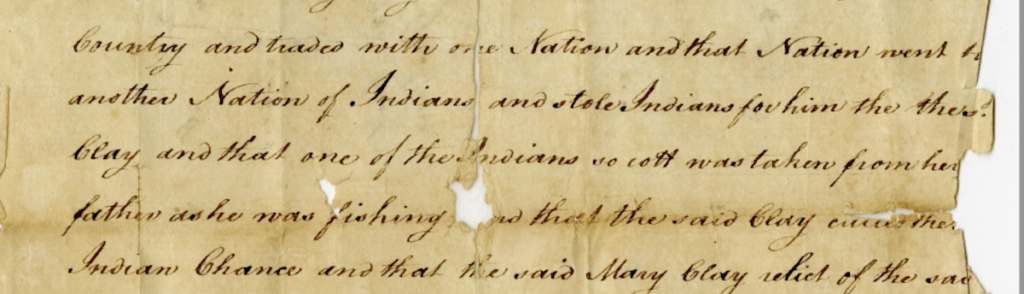
The story began with a young girl, afterwards called Chance. She may have been Choctaw, according to the testimony of people who, in 1772 recalled her kidnapping many decades earlier. One witness suggested it was “about sixty years ago,” which meant 1712 about the time Virginia traders were moving into the Carolinas–and taking captives. Another reported that the girl “was taken from her father as he was fishing.” The trader was Henry Clay, among the witnesses was his widow, eighty-five year old Mary Clay. And the defendants in the case included his presumed descendants Charles, Milly, and Thomas Clay, and Richard Newman. (Chance was not the only captive Clay took; the testimony suggests there was at least one other Indian child, a boy.)
If Chance was a free girl, taken “from [her] own Nation unbeknown to [her] friends & relations” as described, her descendants were free, too and the Clays had wrongfully enslaved them on the principle of maternal, heritable slavery. Ancestry was the key. The plaintiffs in the case were described as Chance’s grandchildren– and great-grandchildren. The witnesses said the palintiffs were: “the descendants of the Indian Girl Chance” (Mary Clay); “one of the Indians was named Chance…which she believes was the Grandmother of the complainants Peter and others” (Elizabeth Blankinship like Mary Clay “aged eighty five years”); “Peter and others, Indians Plaintiff…descended from the said Indian Girl, Chance” (Mary Tyre).
In my book Lineage I argue that genealogy was an intimate prctice of individuals and their families, but also work undertaken by governments and other institutions. Here we see the court collecting testimony to confirm what these plaintiffs already knew– they knew their grandmother, and their knew that their grandmother was illegally enslaved, even according to the laws which permitted this multi-generational violence.
Further reading on Indigenous slavery and freedom suits in Virginia:
Honor Sachs, ““‘Freedom by a Judgment’: The Legal History of an Afro-Indian Family.” Law and History Review 30, no. 1 (February 2012): 173–203.
Kristofer Ray (2016) “The Indians of every denomination were free, and independent of us”: Anglo-Virginian explorations of indigenous slavery, freedom, and society, 1772–1830, American Nineteenth Century History, 17:2, 139-159.
And beyond Virginia, my colleague at Brown Unviersity Linford Fisher just published a book, Stealing America that takes a sweeping look at the practice of Indigenous slavery across early America including the Caribbean.