
Uh oh. A lot of historians hear the fresh relevance of their research with a sense of dread; certainly, I have spent a lot of time over many years as a historian of women, family, and politics in early America talking about– explaining the seemingly arcane concept and practice of– coverture. It used to be a staple of my classes, and students were regularly confounded by it. But it’s back. Or, more to the point, it’s never gone away.
Coverture is a legal principle that subsumes a married woman’s legal identity and capacities to her husband. My first book Not All Wives was an attempt to grapple with what that might mean for women in early American who were not married– had not yet married, never married, or widowed. Did they retain the capacities married women lacked, or were there more gender practices at work that would keep all women at least somewhat subordinated?
As a theological principle the idea that women should be subordinated to a husband (or father) has purchase in religions around the world. And it may be gaining either traction or certainly prominence as extremely conservative Christians are more apparent in the media and politics. The political translation of women’s subordination is sometimes described as “household voting,” or the notion that a husband/ father/ patriarch should represent the household/ family for the community and polity. As we hear more about fringe-into-mainstream ideas about repealing the 19th amendment (which gave most women– not all women as Jim Crow restrictions still disfranchised many– the right to vote), it’s worth revisiting just where this comes from.
The legal roots in the Anglo American tradition are summarized in William Blackstone’s Commentaries on the Laws of England. First published in Oxford in 1765-1769, Blackstone’s work has been described by scholars as having over emphasized agreement and tradition about English legal practices and status, but there is no question that Blackstone had an enormous influence in the British colonies and then the early United States. I have a forthcoming essay about Blackstone editions in America that tracks how closely and conservatively Blackstone was followed despite the revolution. But the point is that Blackstone is a reasonable stand in for a basic understanding of coverture as a legal concept– and for how it got written into statute in America. Brief excerpts from Blackstone’s volumes 1 and 2 are on the National Constitution Center’s website, where he discusses the major points.
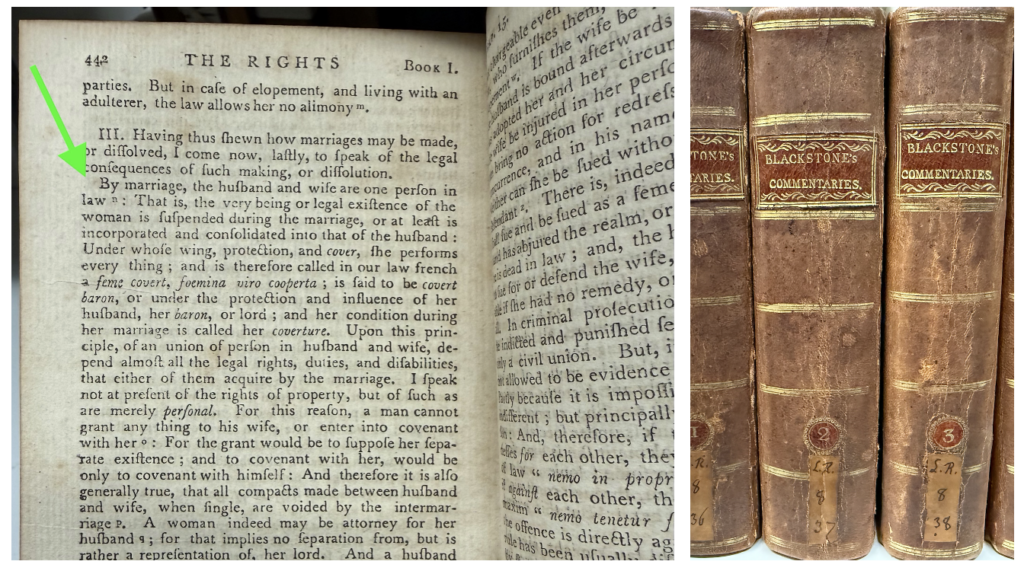
Basically, coverture is the legal maxim that, as Blackstone summarized, “By marriage, the husband and wife are one person in law.” In practice this meant several things. First, that women could only own (that is hold and give or sell or bequeath) certain types of property (mostly personal things, like household goods and clothing), while if she owned real estate her husband would become the manager of it, meaning he could make all sorts of decisions about maximizing its value, up to selling it which he could only do with her agreement. Her agreement would be certified in a local court, and scholars have spent a good amount of time analyzing how women’s agreement was or was not coerced and in what contexts. On a husband’s death, his widow would inherit 1/3 of his estate for her life use (the “dower portion”), after which it would descend to his heirs (typically imagined, their sons).
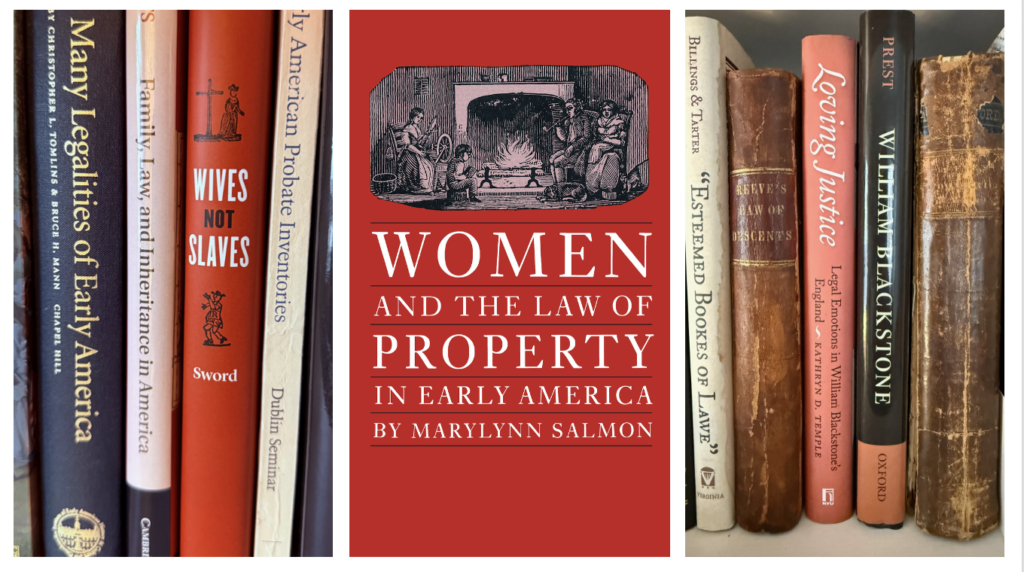
There were lots of permutations of coverture’s application across Anglo-America. Wealthy families sometimes carefully bequeathed property to their daughters with the proviso that her husband not have the ability to manage it. These “separate estates” have been read closely for what they reveal about the many ways that a strict patriarchal system required modification in particular cases. Some scholars have noted that Blackstone’s generalizations were just that– that coverture was always more particular than his summaries suggested.
And in the American colonies and then United States, there were basic similarities but some distinctions. Among the most poignant were changes to the law that made enslaved people variably real estate or personal property and thus either part of an estate that was not part of a widow’s 1/3 –or was. The implications for wealth building among enslaving families and conversely for violent disruption to enslaved people and their families was profound.
In 1850 the Married Women’s Property Rights Act was one step toward providing married women more secure access to ownership rights. Yet the vestiges of coverture remain salient; let’s keep mixing metaphors and say that the tentacles are long. When I was a kid my mom was finally able to get a credit card in her own name, thanks to the Equal Credit Opportunity Act of 1974, which disallowed discrimination against credit applicants on the basis of sex, race… and marital status.
This was meant to be a brief post, and it’s already a bit too long but the point is really important. Married women have been specifically disadvantaged under the law, and have been treated not as capable, independent individuals living and performing civic functions in a democracy but as appendages of their spouses. Women may choose, under the principles of a free society, to conduct their marriages mostly as they like, but the harshly conservative view that all women must be bound under a patriarchal household model has been discarded over time as inconsistent with democracy.
Coverture is worth understanding, both as law and as cultural view and social practice.