
“Know all men by these presents that I John Blakemore of the parish of Hamilton in the County of Prince William Planter….In witness whereof I have hereunto set my hand and seal this 27th Day of October 1750.”
There are so many joys of talking with folks around the country (and beyond!) about my book, Lineage and the history of genealogy in early America. One of the most challenging things to convey is often also the simplest: that genealogy was work to account for ancestry undertaken by individuals and families about themselves and their ancestors, but also by unrelated people and institutions for their own purposes. Governments, to take the most prevalent example, have always been interested in who was related to whom. For all kinds of reasons, governments track family connections. It is true now, and it was true in the eighteenth century. Genealogy is one of the most popular activities people undertake, and it can offer a lot of meaningful insight. But that doesn’t change that it’s also had this other dimension.
So how do we see that in action? Sometimes people look at some of the materials I share on screen or hear me discuss in a talk, and wonder “how is that genealogy?” So I thought I’d work through a couple of examples. I’m starting with this deed is from Lancaster, County, Virginia, on the northern shore of the Rappahanock River where it meets the Chesapeake Bay. It was written and signed by John Blakemore in 1750. I chose it pretty much at random from the excellent digital collections of the Library of Virginia (in their “Virginia Untold” materials).
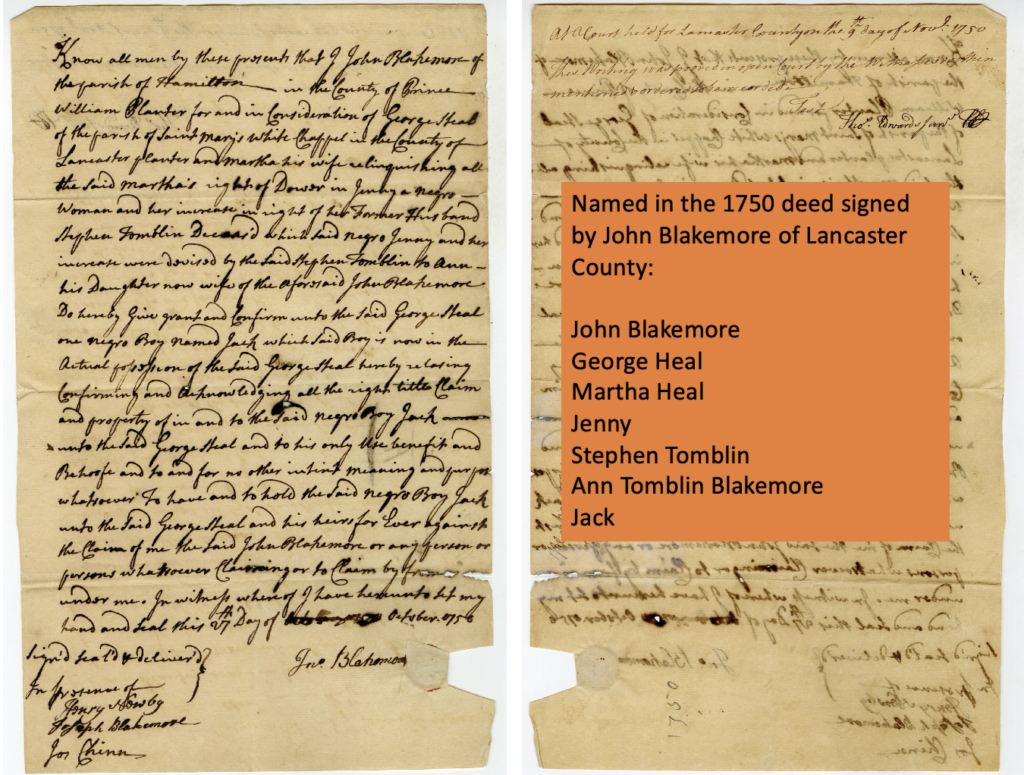
Front and back of 1750 deed signed by John Blakemore, Lancaster County for “Jenny etc,” Library of Virginia’s “Virginia Untold” digital collection.
The deed is John Blakemore’s, with George Heal. The two men are essentially agreeing to exchange an enslaved woman (and her future children) for an enslaved boy. But there is detail in this document that helps us see it as a form of genealogy. Seven individuals were named in this deed: John Blakemore, George Heal, Martha Heal, Jenny, Stephen Tomblin, Ann Tomblin Blakemore, Jack. Looking at each of them and their relationships, we can see how genealogy is working on multple levels.
First are the family relationships that are articulated in the document. Martha Heal is identified as “Martha his wife,” the wife of George Heal. We know that Martha was previously the wife and then widow of Stephen Tomblin: “her Former Husband Stephen Tomblin Deceased.” And that presumably Martha and Stephen, but possibly Stephen by a previous wife, had a daughter, Ann Tomblin, at the time of the deed Ann Tomblin Bakemore: “Ann his Daughter now wife of the aforesaid John Blakemore.”
One more family relationship is named in the deed: that of Jenny and her future children. Jenny was key to this deed, described as “Negro Jenny and her increase.” Her children, identifed as anticipated property, exemplify what historian Jennifer Morgan has written about so fully and with such insight in Reckoning with Slavery: Gender, Kinship, and Capitalism in the Early Black Atlantic. Black women’s families were made hostage to a double-edged inheritance structure, which which their children both inherited their mother’s enslaved status and would be considered heritable property.
Second, the property laws which structured inheritance, and which were so bound to ideas and practices of genealogy, are the key to understanding what was happening in this deed. There are several things to pay attention to here. There are explicit and implict invocations of the law in the language of the deed. The deed itself is about essentially two branches of a family exchanging Jenny (and her unborn children) for an enslaved boy, Jack. What is never clearly stated is that under Virginia law slavery, including maternal heritable slavery, was not only permitted and implemented, but facilitated.
What is made explict is that Martha Heal, previously Martha Tomblin, was actually the owner–or at least owned the use of–Jenny, under the laws of coverture. As part of her “dower,” or access to 1/3 of Stephen Tomblin’s real property (which is how enslaved people were defined under Virginia law, as real estate, essentially), Martha had inherited Jenny and had to approve her exchange for Jack. Thus the deed states that “Martha… [was] relinquishing all the said Martha’s right of Dower in Jenny.” And she did so because Ann and John would then “Give grant and Confirm unto the Said George Heal hereby [relating] confirming and Acknowledging all the right title Claim and property of in and to the Said negro Boy Jack.”
Third, while we might see here just two generations articulated, in particular Jenny and her children and then Martha and her daughter (with Stephen), Ann, in fact there are at least three generations anticipated in this document. Ann and her husband John Blakemore granted George “to have and to hold the Said negro Boy Jack unto the Said George Heal and his heirs for Ever.” Stephen Tomblin and Martha Tomblin Heal’s daughter Ann Tomblin Blakemore and their prospective grandchildren (and more) by Ann and John Blakemore all existed in this deed.
And so, even a fairly dry legal instrument like a deed is a form of genealogy. It articulates a specific set of family relationships in the context of a specific expectation (in this case, the law of property in British America, including slavery). It anticpates multiple generations. And it reflects the importance of genealogy –not only as a matter of private interest, but of public policy. I could have selected an example recounting a much richer set of generational relationships, but I’m glad I stuck with something I’d selected mostly at random (for different reasons I was lookng for mid-century court records from Virginia).
Oh, and one more thing. Among the 3 witnesses to this deed? Joseph Blakemore. Sibling? I’m on to looking at a different 1750 document for another example of public documents as an important form of genealogy in early America.