When I make a list of issues I care most about as a historian, footnotes are at the top. Footnoting (this is not an invitation to debate the comparative virtues of endnotes versus footnotes, or whether publishers who want authors to bury their notes are right or wrong) is a traditional practice with critical value for an age awash in information mush (or worse). Footnotes are a contract between author and reader; they let you know where to find the information that the author has leaned on to make their assertion or observation.
As a practice, footnoting is just as important online as it is on the page. You know how this is, right? You see something on social media that seems right and it’s compelling. So you like it or share it! This happens a lot with history content. So many people are excited about and interested in history, and that’s fantastic. It makes them want to read and learn and share. But I’m anxious enough about the sheer volume of misinformation in our systems, and enough of a historian to know why it really matters that we have access to and can share full and accurate histories that I won’t do that. I’ll never repost or engage with anonymous history content creators not because they don’t sometimes have useful things to share but because I don’t know where it comes from. You’ll notice that high integrity creators do one of several things: they will actually point to their sources in their posts or newsletters (see Heather Cox Richardson’s newsletters, for example, in which she carefully lists her sources at the end of each); they will identify who they are, whether individual or organization so you can assess their experience and expertise (look at how archives and libraries share materials from their collections, for example); they will include links in the posts.
In a world of swirling information, it can be hard to know how to assess what someone is saying. That’s true in traditional text media as well as online, and it’s also true that someone can link a source but be distorting or misunderstanding that source in a way that makes their post misleading. But in general, the more information you have about who is doing the work to share information, and about the basis for that information, the better. It’s just good information hygiene.
Last week I shared a piece I wrote about Martha Washington for the new initiative for In Pursuit (yes, the one in which President George W. Bush’s essay about Martha’s husband got a lot of attentions). A keen reader will note that the piece quotes Martha and others, but it does not in fact have any footnotes (or other forms of sourcing). So I thought I’d tell you both a bit about the editorial process and then also share the materials I was quoting and referencing.
I wrote two pieces about why I think that the essence of footnoting — basically, showing your work– is essential for democracy. It’s about the accountability and transparency necessary for an engaged and educated civic life. One was in Made by History for the Washington Post, where I said:
We are at a distinctive point in the relationship between information and democracy: As the volume of information dissemination has grown, so too have attempts by individuals and groups to weaponize disinformation for commercial and political purposes. This has contributed to fragmentation, political polarization, cynicism, and distrust in institutions and expertise, as a recent Pew Research Center report found. So what is the solution?
Footnotes.
The other piece was in the Scholarly Kitchen almost ten years ago! I walked through some of the work on the history of footnoting. But my argument was very much the same: “The humble footnote, seemingly the province of scholars, plays an important role beyond the world of scholarly expertise…..Whereas opinion requires thought (more or less), scholarship requires evidence…For a specialist reader the evidence is more easily assessed, but for the non-specialist the footnote is a signal that the evidence could be sourced to its roots in that lab, archive, or dataset. Could you put nonsense in a footnote? Sure. But the footnote at least gestures to the obligation of providing evidence for assertions and conclusions.”
Back to Martha Washington. The In Pursuit team required footnotes in the materials we submitted, and the editorial team checked our work carefully. They also caught errors — people, this is why we must have editors. Among other things in the midst of moving and adapting some text I mistook Martha’s birthdate! So yes, the piece was thoroughly sourced, and reviewed. You can read also a short piece I did earlier this week about secondary sources, other scholars’ work that was incredibly important to how and what I wrote about the first First Lady, including the Papers of Martha Washington.
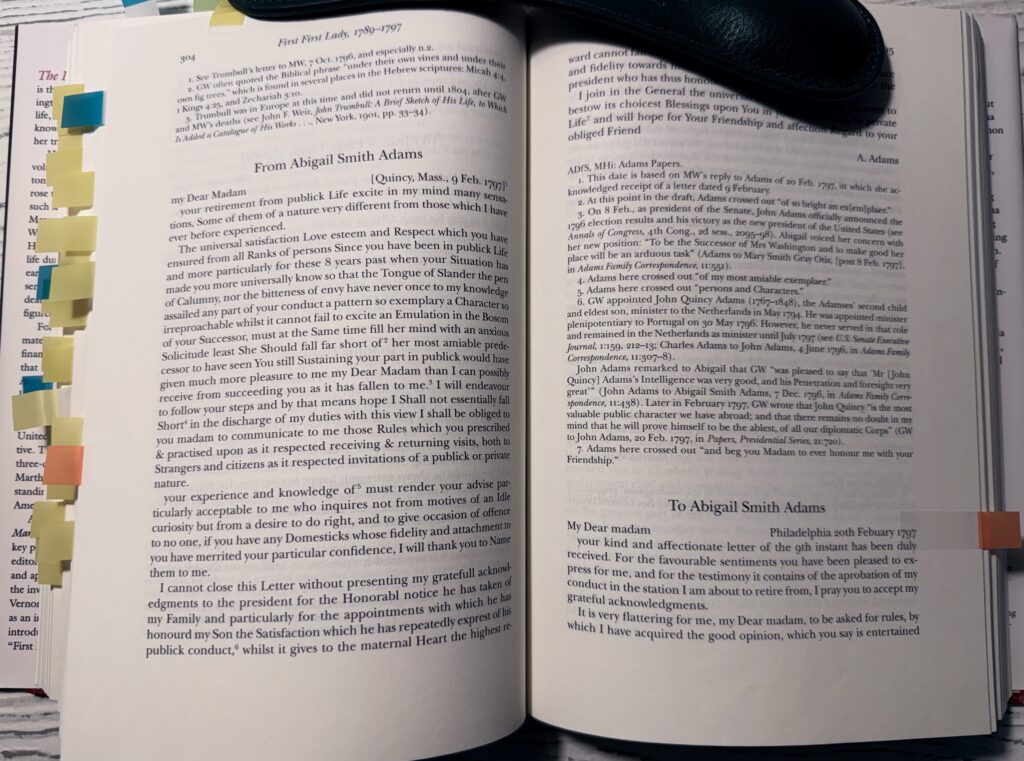
Here then are the passages with quoted material, and the references to the primary sources with the link if available:
“In a few surviving letters, George refers to her as his “dear Patcy,” and they addressed each other as “My Dearest.”George signed one urgent letter in the summer of 1775 as “Your entire.” George to Martha Washington, Philadelphia June 18th and 23rd, 1775.
“In the transition from colonies to nation, their friend the historian and writer Mercy Oris Warren said, “events have outrun [our] imagination.” Mercy Otis Warren to Martha Washington, Plymouth, November 27, 1789 in The Papers of Martha Washington (Charlottesville, University of Virginia Press, 2022), 195-196.
“Martha would hold what a friend described as “the first rank in the United States.” Mercy Otis Warren to Martha Washington, [c Dec 1789-March 1790], Papers of Martha Washington, 199-200.
“The Washingtons would step carefully but decisively, together, into this phase of their “public life.” Martha Washington used this phrase regularly but for example Martha Washington to Mercy Otis Warren, New York, December 26, 1789. Papers of Martha Washington, 197-198.
“She stocked the Washington’s capitol city residences with such supplies as china decorated with of all the states around the rim of the plates and her own initials in the middle, cutlery, wine, and more prosaic items like “mops and Clamps for scouring brushes.” Martha Washington to Clement Biddle, [New York, 1789-1790]. Papers of Martha Washington, 201.
“Martha described both formal and less formal visits: “the practice with me has always been to receive the first visits, and then to return them”; these included “the ladies of the diplomatic corpps…introduced in their first visits by the Secretary of State.” Martha Washington to Abigail Adams, Philadelphia, February 20, 1797. Papers of Martha Washington, 305-306.
“Martha wrote of longing to be in “the shades of mount Vernon, under our own vines and fig tree.” Martha Washington to John Trumbull, January 12, 1797. Papers of Martha Washington, 303.
“For herself, Martha “determined to be cheerful and to be happy in whatever situation…for I have also learnt from experience that the greater part of our happiness or misery depends upon our disposition.” Martha Washington to Mercy Otis Warren, December 26, 1789. Papers of Martha Washington, 197-198.
“At the end of Washington’s presidential administration, Abigail Adams wrote to the only woman to serve in the position she was about to hold that she would “endeavor to follow your steps and by that means hope I Shall not essentially fall Short.” Abigail Adams to Martha Washington, Quincy, February 9, 1797. Papers of Martha Washington, 304-305.
So yes, I feel firmly about footnoting! There are too many places in public life right now where people are over casual about information, not even bothering to acknowledge that obligation even when they pretty easily could. Among my critiques of the “Founders Museum” housed on the White House website, for example, was that even for the eighteenth-century people with the most extensive documentary record, there was no effort to provide source information. I was also very salty about President Obama’s decision not to provide source information in his memoir of the presidency. I’ll always, pace Mr. Rogers, look for the footnotes.