
[The cover image is a page from Jefferson’s “Farm Book” at the Massachusetts Historical Society where he listed enslaved recipients of “Bread” at Monticello in 1810 –including Sally Hemings and four of her children.]
The short version: a team (led by the Smithsonian) has been working with a strand of Thomas Jefferson’s hair to compare recovered DNA with that contributed by descendants of Sally Hemings. A previous study in the late 1990s found that a Jefferson male had fathered one of Hemings’s sons. Now, advances in genetics allowed for a more thorough and sophisticated analysis deminstrates that the odds are “less than one in a thousand” that Thomas Jefferson was not the father of at least two of her sons.
If you’re wondering if, in this 250th year of commemorating the founding of the United States, we need to revisit every fresh vantage on early American history, apparently we do. If you’d already read plenty on the important historical work demonstrating so far beyond a reasonable doubt we’re in planetary orbit that Thomas Jefferson fathered the children of Sally Hemings, the enslaved half sister of his dead wife, you’re probably wondering what else there is to say. And if you’re me, and you’re a historian atuned to the politics of genealogy, your eyebrows are raised not by new evidence –that’s fine and cool– but by the idea that yep this new DNA evidence either settles the case or offers yet another round of the same old “but would he really” and “how do we know for sure” and “what about that other Jefferson guy.”
Sadly, this recent flap mostly reveals that we have a hard time thinking historically with much sophistication — and often the media undermines our capacity rather than enhances it. And the histories of family are even more vulnerable to these dynamics. History, what we know about the past, is interpreted through evidence (documents, yes, but so much more). Which means what we know can change with new evidence and new perspectives. But also that expert interpretation comes from deep analysis, experience, and judgment and can in fact settle matters for us. But science, too, it turns out, is reliant on materials and process. DNA is quite interesting! It is no more or less affirmative and folks paying attention to the complexity of genetic genealogy will understand how important it is to contextualize it within other historical materials.
Let’s rewind to the 1990s. I was already teaching histories of family, and in fact the year that Annette Gordon-Reed’s outstanding book, Thomas Jefferson & Sally Hemings: An American Controversy was published (1997) I was teaching an undergraduate research seminar (I was then at American University) on Sally Hemings. The students scoured newspapers, the Jefferson papers of course, and we traveled to Monticello to meet with the folks leading the Getting Word project, an early project incorporating descendants of people enslaved at some of these famous sites. If you haven’t heard of or spent time recently learning more about the project I can’t recommend it enough. This work of descendant communities is one of the most powerful demonstrations of the ways that genealogy is a powerful tool for communities and for history as well as individuals and their families.
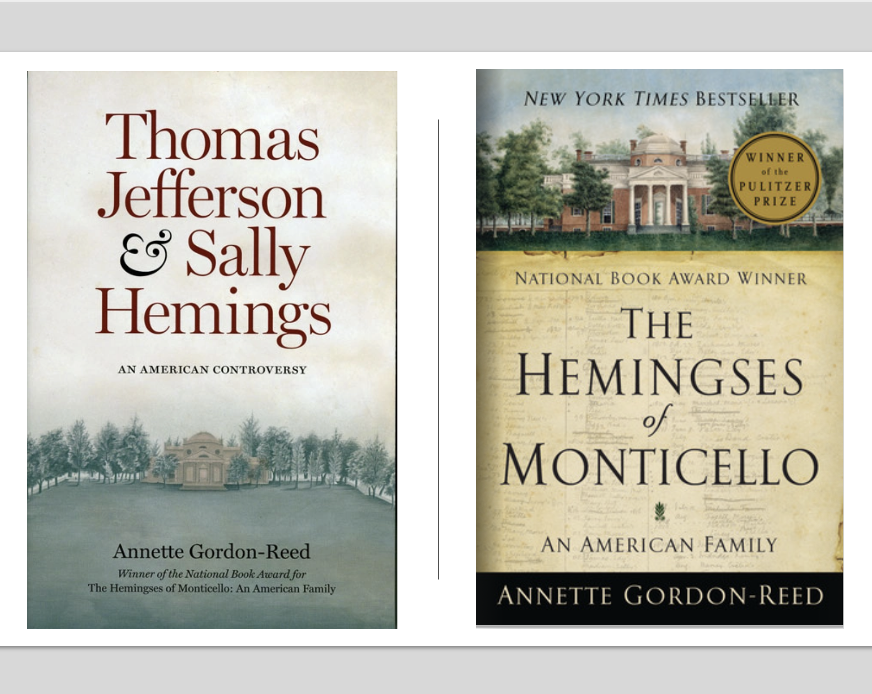
Gordon-Reed would go on to write, and win the Pulitzer, National Book Award and more for The Hemingses of Monticello: An American Family in 2008. But Thomas Jefferson & Sally Hemings was a thunderbolt book for two reasons. First, the relationship and the children of Jefferson and Hemings was known in their lifetimes and since but white Jefferson descendants, historians, and others resistant to the long and deep history of sex and sexual violence in slavery had more than obscured it in the later 19th and 20th centuries. Except to Hemings descendants, for whom this was their family history. Second, Gordon-Reed is an excellent historian but she trained as a lawyer and she laid out the preponderonce of evidence with exceptional skill. She showed not only how much effort there had been to resist this history, but all the ways that those resisting arguments were wrong or highly improbable. One of the arguments for a long time had been that while okay sure maybe a Jefferson had fathered Hemings’s children, but it couldn’t have been Thomas, not he of the Declaration of Independence. Some historians with a blithe and chilling combination of mysogyny and racism basically said no, he wouldn’t have been attracted to her. Many had no idea how much work historians had been doing to document the sheer volume of relaitionships among men of Jefferson’s circle with enslaved women (sometimes living with them openly, like his lawyer in Richmond). But Gordon-Reed demolished all this with a careful calendar calculus. When was Jefferson at home, when was she pregnant. This is just one example of the way she laid out the evidence and asked the reader to evaluate it.
In other words, the effort to disprove Jefferson’s relationship with Hemings took so many leaps of logic and so much ahistorical contortion that one has to wonder– why? Actually, one doesn’t have to wonder. In the Virginia where Jefferson and Hemings lived, men and women could not legally marry across the color line until 1967 more than a century after a war to end slavery and two centuries after their first child was born.
The DNA study is being published in a research paper as well as in a new book; History By a Hair will be released by Penguin next week. There will be some predictable responses– and some from unpredictable quarters. The Chronicle of Higher Education published this week the story of one of one of the Hemings descendants who contributed a DNA sample and feels dissatisfied with communications from the team of scientists and has very recently withdrawn both her genetic material and permission to use it. You may draw your own conclusions about what happened there, but it won’t have any bearing on the study. What’s fascinating to me is that this descendant is sure that Jefferson could not have been her ancestor. She told the Chronicle that “Based on what she knows about the founding father, she doesn’t think “a man of that integrity would get involved” with Hemings.”
More problematic is the failure of most of the flurry of media attention to the new DNA test including the Chronicle story to resist tired and tiresome framings. One is that there is a remaining “controversy” about the history. There really isn’t. Some people don’t like the history, that’s true. And the second is the “maybe now we really know” framing of DNA as if the genetics are more certain than the historical analysis. Is there a 100% certainty in either case? Of course not. We know that there is almost nothing that can provide us with with 100% certainty. Equally there are few matters that offer as much persuasive historical evidence as the family history of Thomas Jefferson and Sally Hemings.
If you’re interested in reading more about family history as history, I’ve written six posts here and there will be many more to come as I revamp my website (coming soon)! If you’re heard me speak or read more of my work you’ll know how strongly I feel that capital H History regularly skips or dismisses the essential history of family– which is both deeply embeded in culture, law, economics, politics, and more and shapes all of those features of society. Here’s the first of those “Reading Family History.”