
In the collections of the Smithsonian’s National Museum of American History is one of three surviving dresses known to have been worn by Martha Washington. The Smithsonian tells us that “the gown’s basic style is typical of the early 1780s.” It’s made of stunning fabric. The “painted pattern on the silk taffeta is a repeat of four floral bouquets and 58 creatures (butterflies, ants, beetles, snails, bees, grasshoppers, wasps, ladybugs, spiders, and grubs) places within the spaces between the ribbon-trellis pattern. Each crossover is accented with a painted green “jewel.” If you are startled by the idea of Martha Washington in a silk dress with 58 creatures and painted green jewels, you’ll want to check out the purple silk shoes, with silver embroidery and sequins, that she wore when she married George.
But she wasn’t just an empty dress, or a pair of fancy shoes.
I’ve been studying Martha Washington’s life for as long as I’ve been a historian (which is a long time!) but she has been a shadow figure in a lot of my work. As I wrote about George Washington, for example, she (and her extended family) was background. As I wrote about eighteenth-century women, especially widows, I thought more about women in urban Philadelphia before she lived there. And in my recent book about how early Americans understood genealogy as cultural, legal, and political infrastructure, I left her out again. Arguably the most famous American woman of her time, she probably deserved a bit more of mine.
Luckily, last year I was asked to write an essay about Martha Washington for In Pursuit, “a new initiative from More Perfect, led by the country’s most insightful and respected students of history, to review our first 250 years and distill its most timeless lessons to inspire and inform our future.” The assignment to In Pursuit authors was tight: 1250 words, and with a lesson–and accompanying aphorism to encapsulate it–about each of the presidents and some of their spouses. Each week in 2026 the essays will be released, starting this week on Presidents Day with President George W. Bush writing about George Washington, and with me writing about Martha Washington. Fun!
You can now read the essays, President Bush writing about President Washington and how “For a Leader, Humility is the Ultimate Strength,” and me writing about the first First Lady, “Before Women Could Hold Office, She Created One,” either on the In Pursuit website or on Substack. And hear them, narrated by the authors, and even watch them as cool videos on C-Span. The project has gotten a lot of press attention, and In Pursuit’s CEO, former Archivist of the United States Colleen Shogan moderated a panel with a group of us authors at the New-York Historical on President’s Day.

Much as I appreciate the work and support of the terrific In Pursuit team, maybe true to form it was the research and writing that I most appreciated about this project. I had the opportunity to dig into what we could know about Martha Washington, and what historians had already had to say about her. I could bring my experience and expertise as a historian to bear, but as with all the best opportunities, I could approach this one as a learner — exploring, discovering and reflecting.
Eighteenth-century women, even ones as elite and privileged and famous as Martha Washington, are just a lot harder for us to study than even more modestly situated men. In part this is a general problem– they appear in fewer public documents because once married their legal identity and in many ways their public presence was subsumed by their husbands. In part this is a Martha problem. Very little of the correspondence with her famous husband (she had a first, much less famous husband!) survives; it was said that she burnt it all after his death. Even so, many women were not always married (they were single, never married, and pretty regularly widowed), and even married women appear in a variety of types of textual materials. Even Martha corresponded with a lot of people who were not her spouse, and thus an invaluable volume of The Papers of Martha Washington was published in 2022 as part of the Papers of George Washington project’s work. From more than 60 archives and libraries around the world, the editors gathered as much material as they could; this included only four letters between George and Martha.
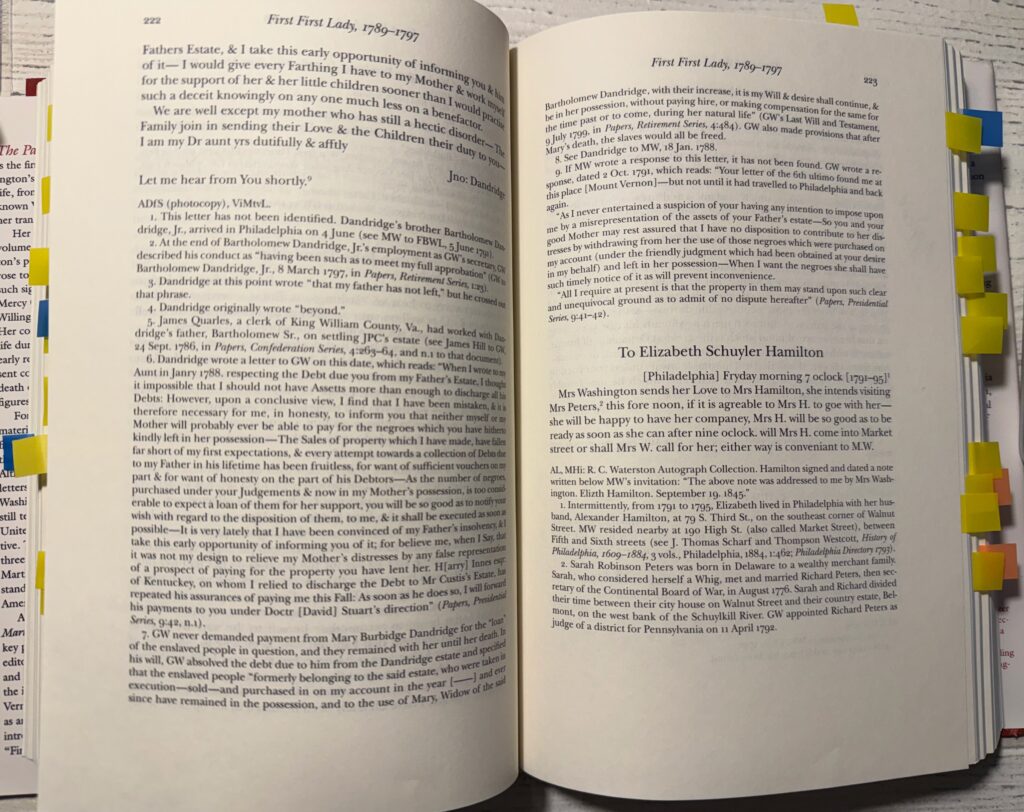
And yet there’s still so little — only about 85 letters that Martha wrote during the Washington presidency, for example, survive (and are published in the Papers volume). Thank goodness the editors undertook this work to make more of Martha accessible. Even the gold-standard publicly accessible resource for the papers of “founders” Adams, Franklin, Hamilton, Jay Jefferson, Madison, and Washington, Founders Online only includes twenty-five texts authored by Martha. As opposed to close to 32,000 authored by her husband. If you’ve never had the joy of reading a volume of expertly edited documents, I recommend the experience. You don’t only get a clean transcription (not everyone’s nerd joy is reading early script), but annotations that explain the context and identify the people.
But there is also material culture, and the built environment– and possibly most importantly, the work that historians have been doing to recreate the world in which she lived. I had to start with the research at Mount Vernon, which has been ambitious about understanding the Washingtons, their family, and the hundreds of enslaved people who lived and worked there and at the Washingtons’ other properties. Among their collections are a remarkable number of items from or about Martha, including those purple shoes, one of the other 3 extant dresses I recommend this blog post by the dress historian Cynthia Chin on one of the others), and some of the Washingtons’ presidency-era china with the states circling the edges and Martha’s initials in the middle. As well as the mansion and other buildings themselves, where you can see the rooms where the hundreds of people at Mount Vernon lived and worked, including the rooms where the Washingtons slept, and the room where Martha slept on the third floor during the year and a half after her husband died and before she died, too.
And of course there are other scholars who have written about Martha Washington, whose work was essential to mine. Five –all of which are great reads! — top the list: Erica Armstrong Dunbar’s Never Caught: The Washington’s Relentless Pursuit of their Runaway Slave, Ona Judge; Flora Fraser’s The Washingtons: George and Martha Partners in Love and Friendship; Cassandra Good’s First Family: George Washington’s Heirs and the Making of America; Marie Jenkins Schwartz’s Ties that bound: First Ladies and Slaves, and Mary Thompson’s The Only Unavoidable Subject of Regret: George Washington, Slavery, and the Enslaved at Mount Vernon. These are the books I returned to most regularly to place Martha Washington within eighteenth-century Virginia, at Mount Vernon, in her family, and then in the context of the revolution and new nation. That’s why the deepest consideration of slavery is so important. Martha lived supported by the institution of slavery and surrounded by enslaved people all her life. The density of her own family connections was matched by the density of family among the people that she and George enslaved, and understanding the particular as well as general contours of those dynamics is essential to understanding her life and experiences.
There is a lifetime’s worth of scholarship and even more general audience writing about George Washington, and many more books about politics in the early United States that I could list, too, and that have influenced my work. One that will appear in an upcoming installment of In Pursuit is Catherine Allgor’s book Parlor Politics: How the Ladies of Washington Helped Build a City and a Government which credits Dolley Madison’s social finesse with crafting the political culture that made partisan Washington start to hum; you can see the beginnings of that in the hostessing that Martha innovated in her years as First Lady. Too, Kate Haulman’s The Mother of Washington in Nineteenth-Century America highlights not only how George Washington’s mother Mary Ball Washington reflected expectations of women in early Virginia, but how they were interpreted as the nation began to galvanize a nostalgic memory of both George and Martha.
Writing a brief essay about Martha Washington, in short, was an undertaking. It sent me back into the archives, back to the scholarship, and back to the material contexts that show us so much about how she lived. It also sent me back to my original interest in how the Washingtons thought about family in their world defined by it; more on that soon.